THE FUTURE OF ARCHAEOLOGICAL RECONSTRUCTION
ARCHEON is an experimental artificial intelligence system being developed by Blue Arc to study, interpret and reconstruct the ancient world through fragmented evidence.
Ancient history rarely survives intact.
THE ANCIENT WORLD IS INCOMPLETE.
Much of what survives from ancient civilizations exists only in fragments.
ARCHEON is being developed to examine those fragments as evidence — bringing archaeology, history, materiality, geography, imagery and comparative knowledge into one analytical system.
The objective is not to recreate what we imagine was there.
It is to determine what the surviving evidence allows us to reconstruct.
HOW ARCHEON THINKS
EVIDENCE → COMPARISON → HYPOTHESIS → RECONSTRUCTION
THE ARCHEON EVIDENCE FRAMEWORK
ARCHEON evaluates archaeological material through a structured network of interdependent evidence domains.
Each object, fragment or site is examined not as an isolated artefact, but within the broader archaeological, historical and material conditions that define it.
MATERIAL
Composition, stone or clay type, pigments, metals, manufacturing traces, technical characteristics and material provenance.
FORM & STYLE
Anatomy, proportions, morphology, ornamentation, craftsmanship, stylistic conventions and regional characteristics.
ICONOGRAPHY
Attributes, gestures, symbols, costumes, figures, narratives and established representational conventions.
CHRONOLOGY
Period, dating, historical phases, stylistic development and chronological relationships.
CULTURAL CONTEXT
Civilization, cultural tradition, religious environment, political authority and social context.
ARCHAEOLOGICAL CONTEXT
Findspot, stratigraphy, associated structures, neighbouring discoveries, excavation records and original architectural setting.
COMPARATIVE RECORD
Known parallels, related objects, workshops, sites, publications, museum collections and previously documented examples.
PROVENANCE & DOCUMENTATION
Excavation history, ownership, archival records, previous interpretations, restoration history and scholarly documentation.
FROM EVIDENCE TO HYPOTHESIS
ARCHEON does not treat archaeological evidence as a collection of isolated data points,It establishes relationships between them.A material characteristic can inform provenance.Provenance can inform trade.Trade can inform cultural exchange. Cultural context can inform iconography. Iconography can inform identity. Form and anatomy can inform reconstruction. Chronology can confirm or challenge the entire interpretation. The system continuously compares these relationships against the accumulated archaeological record.
RECONSTRUCTING THE LOST
Archaeological reconstruction is rarely a matter of simply restoring what is missing. The missing element must first be inferred.
ARCHEON is designed to examine the surviving physical evidence and determine which reconstructions are most compatible with it — using geometry, proportion, material, technique, chronology, style, iconography and comparative archaeological evidence.
A missing hand may indicate a particular gesture., A surviving fragment of drapery may indicate a specific pose., The curvature of a vessel may reveal its original profile. The surviving geometry of a mosaic may determine the structure of a missing pattern. A fragment of architecture may reveal the proportions of an entire structure.
The system can then generate and compare reconstruction hypotheses rather than treating a single reconstruction as fact.
The objective is not to fill the gap.
The objective is to understand the constraints of the gap.
This is already emerging as a serious area of computational heritage research: AI and computational systems are being explored for fragmented-object reconstruction, 3D completion, mosaic reconstruction and fragment matching. The important distinction for ARCHEON is that reconstruction would sit inside a much broader evidence-based archaeological reasoning system, rather than functioning as image generation alone.
CASE STUDY
THE COLOSSAL STATUE OF PHILADELPHIA
What can a fragment tell us about what has been lost?
This is where we introduce the surviving elbow and fingers, the marble, the colossal scale, the Greco-Roman characteristics, the temple context and the comparative evidence.
And importantly, this slide should be almost entirely visual — the reconstruction on one side, the surviving fragments on the other, with ARCHEON sitting between them.
-
THE FIRST RELATIONSHIP
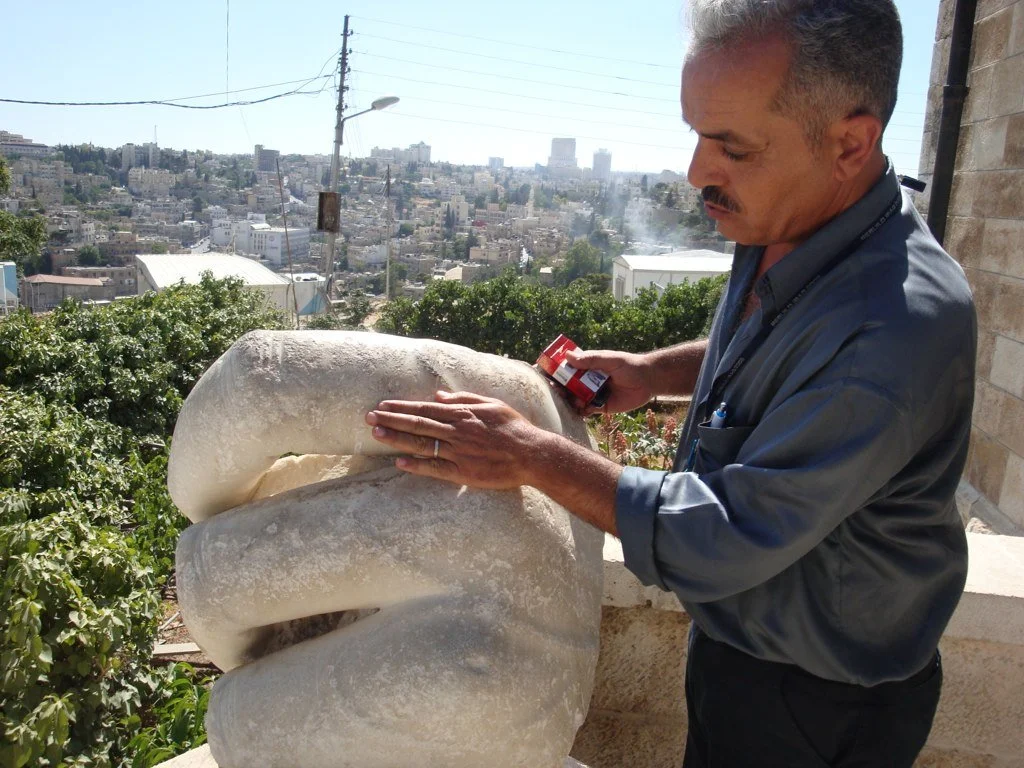
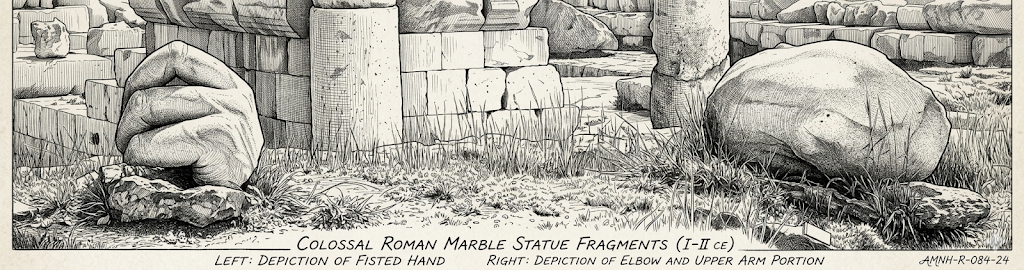
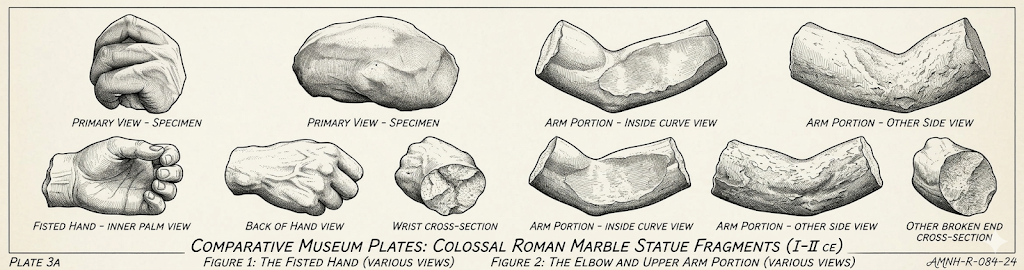
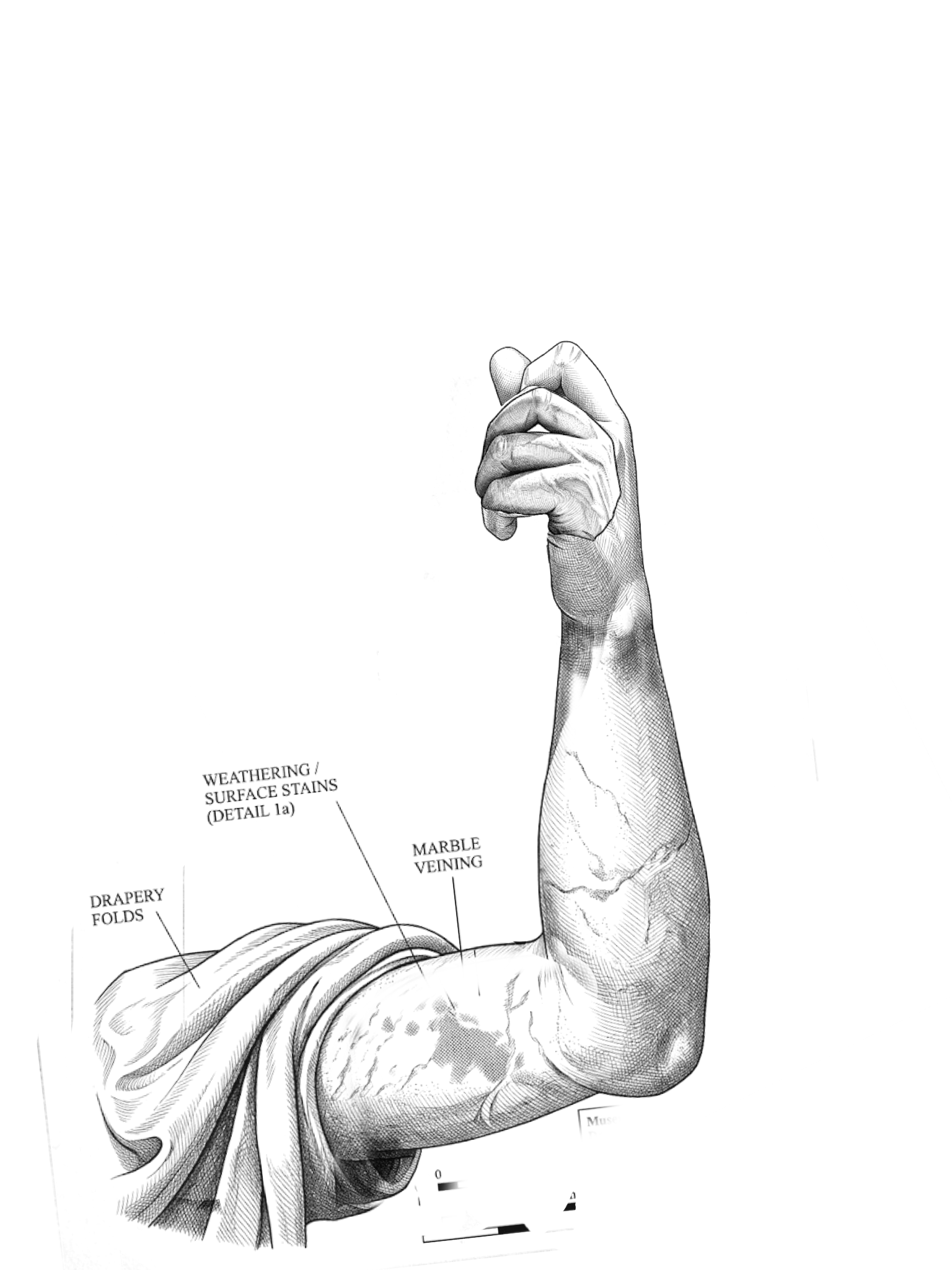
The surviving hand preserves three fingers.
The surviving elbow preserves part of the upper and lower arm.
When these fragments are examined together rather than independently, a possible anatomical relationship begins to emerge.
The geometry of the elbow establishes an orientation for the forearm.
The position and curvature of the surviving fingers provide information about the orientation of the hand.
Between the two fragments lies an unknown distance.
That distance is not arbitrary.
It can be modelled.
By reconstructing the missing anatomical relationship between the elbow and the hand, a possible arm position begins to emerge.
This creates the first ARCHEON question:
What was the figure doing with this arm?
-
WHAT WAS IT HOLDING?
The surviving fingers are particularly important.
Their position suggests that the hand may not have been simply open or resting.
The possibility of a gripping gesture introduces another variable:
Was the figure holding an object?
If so, the missing object becomes part of the reconstruction.
Its possible dimensions.
Its orientation.
Its relationship to the hand.
Its relationship to the elbow.
Its relationship to the body.
One possibility that emerges from our preliminary reconstruction is a long, vertical object—potentially torch-like in form.
This is not presented as an established identification.
It is a hypothesis generated from the surviving physical relationship.
And this is precisely where ARCHEON begins to become useful.
A missing object is no longer treated as an empty space.
It becomes a constrained possibility.
-
THE LOST BODY BEGINS TO TAKE FORM
If the figure was gripping a long vertical object, the position of the arm becomes increasingly significant.
The bent elbow.
The orientation of the forearm.
The grip.
The scale of the hand.
The monumental proportions of the figure.
Together, these characteristics can be compared against known sculptural compositions.
This moves the investigation beyond:
“What does this fragment look like?”
toward:
“What complete sculptural configuration could have produced this fragment?”
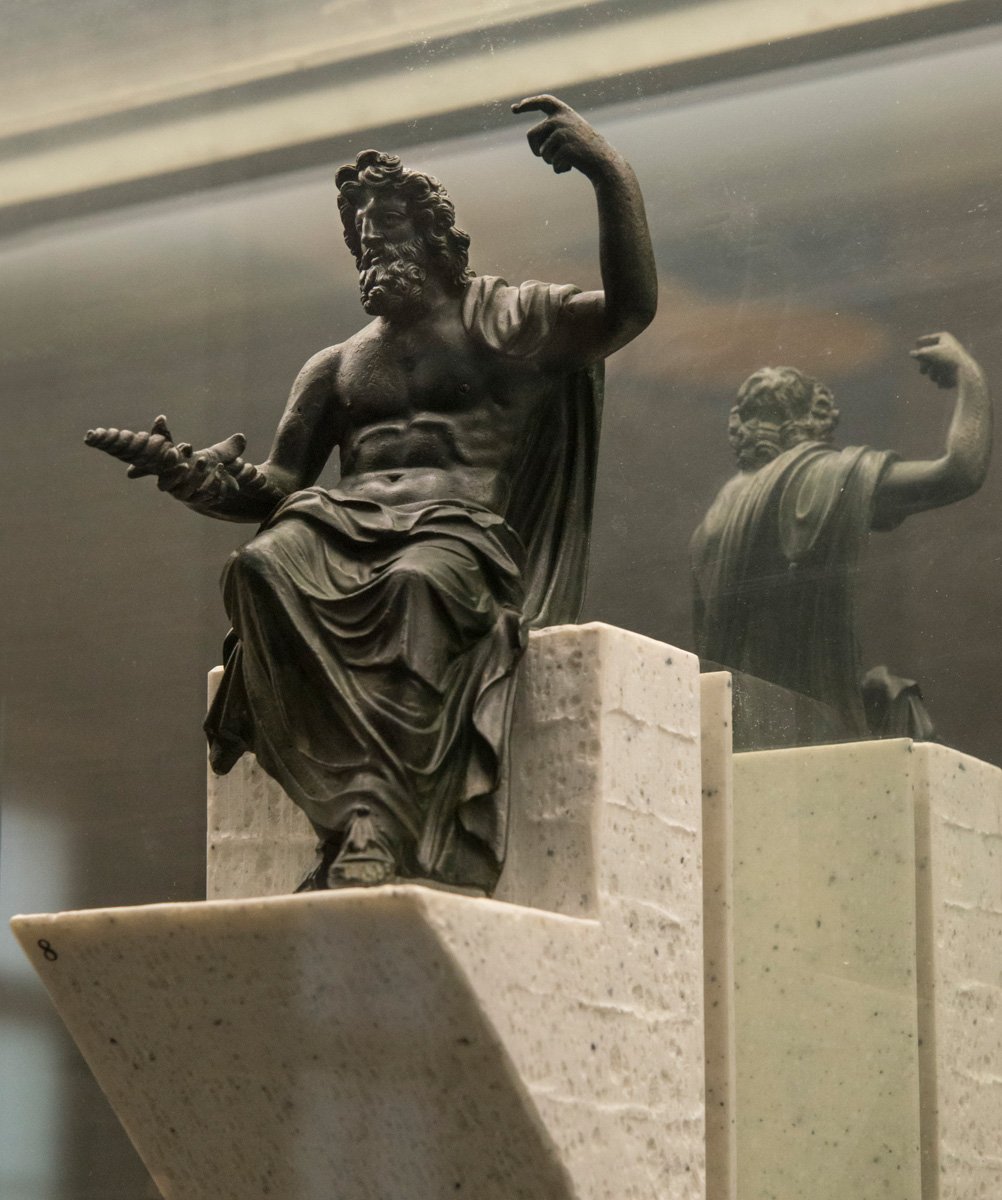
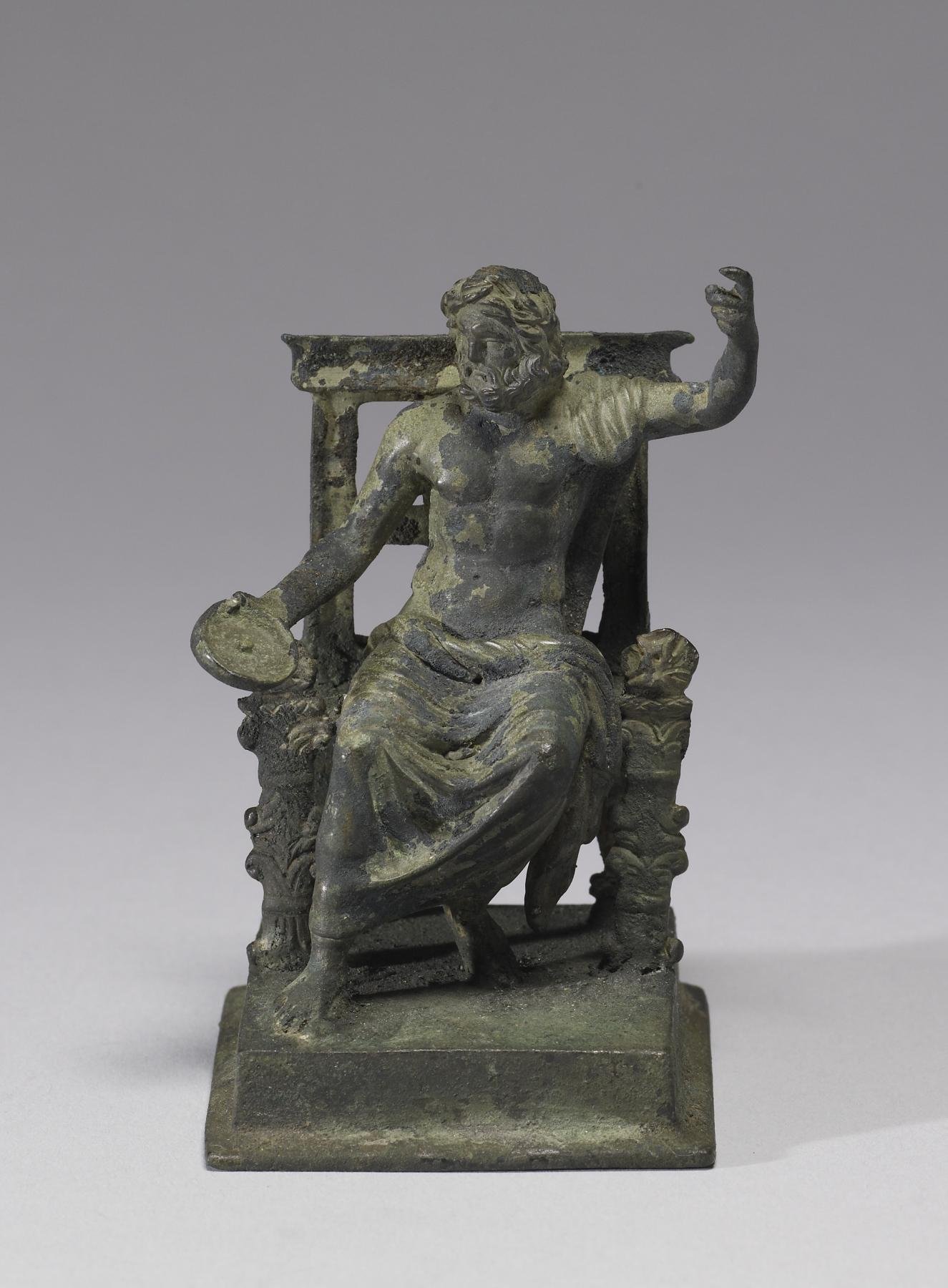
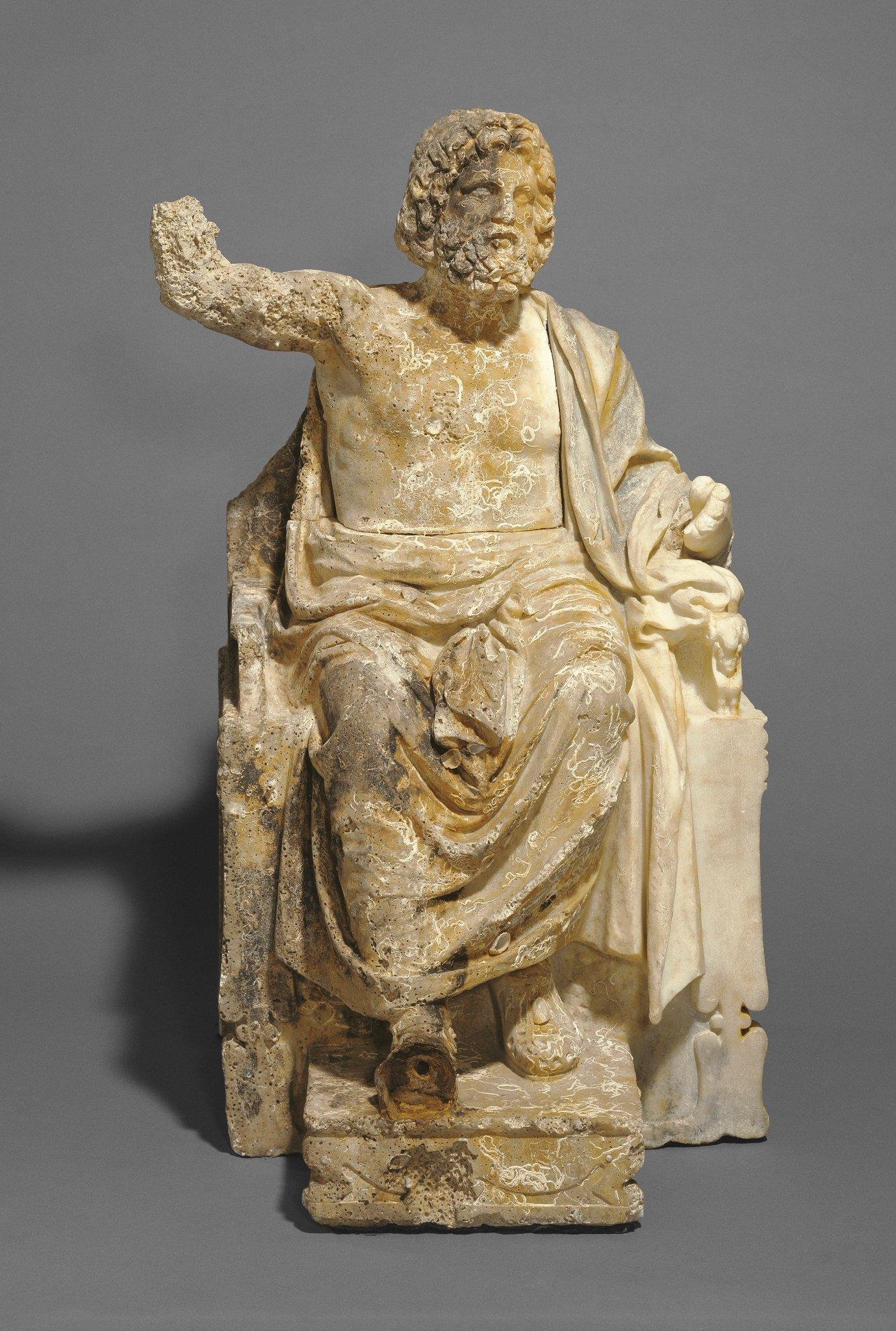
The preliminary reconstruction points toward the possibility of a monumental seated composition.
Not because the system has decided that the figure is Zeus.
But because the surviving geometry can be compared against established sculptural types.
-
THE STATUE MAY NOT HAVE BEEN UNIQUE
Ancient monumental sculpture was rarely created in complete isolation.
Artists worked within established visual traditions.
Compositions were repeated.
Adapted.
Reinterpreted.
Scaled.
Transported.
Commissioned in different materials.
And reproduced across different regions.
A seated divine figure holding an attribute is therefore not an isolated possibility.
Comparable compositions survive across the Greco-Roman world in marble, bronze and other media.
The question becomes:
Which established sculptural tradition best explains the surviving fragments?
This is where comparative archaeology becomes essential.
ARCHEON would not compare the Amman fragments against one statue.
It would compare them against a corpus of related representations.
-
A POSSIBLE CONNECTION
One of the strongest comparative directions emerging from our preliminary investigation is the tradition of monumental seated Zeus imagery.
The most important comparison is the celebrated Zeus at Olympia and the wider family of seated Zeus compositions that followed and adapted this visual language.
The comparison is not based on appearance alone.
It considers:
The seated configuration.
The relationship between arm and torso.
The scale of the figure.
The use of a monumental attribute.
The handling of the arm.
The religious context.
The recurrence of the composition across the Greco-Roman world.
And the historical tendency for major sculptural types to be reproduced and adapted.
This does not establish that the Amman statue was Zeus.
It establishes something more useful:
A testable hypothesis.
-
THE FRAGMENT CANNOT BE SEPARATED FROM ITS SITE
The statue was discovered in the immediate area of the Great Temple on the Citadel.
The temple itself belongs to the Roman period and is generally dated to the reign of Marcus Aurelius, around AD 161–166, during the governorship of Geminius Marcianus. The archaeological publication describes the surviving colossal elbow as having been found in the immediate area of the Great Temple.
Yet the hill itself is much older than the Roman monument.
Archaeological evidence indicates earlier activity on the Citadel, including evidence of earlier religious use.
This distinction is critical.
ARCHEON must therefore separate:
The date of the surviving temple
from
the history of the site
from
the date of the statue
from
the history of religious activity on the hill.
They may be related.
They may not.
The system must determine the strength of each relationship rather than automatically treating them as one historical event.
-
MARBLE IS EVIDENCE
The surviving colossal fragments are marble.
That fact matters.
The marble itself becomes another analytical layer.
Where did it originate?
Was the material locally available?
If not, where was it sourced?
How was it transported?
Was the statue imported as a finished object?
Was the marble transported as blocks?
Was the sculpture carved locally by an imported workshop?
What economic and logistical conditions would have been necessary to execute a monument of this scale?
The material therefore becomes more than a description.
It becomes evidence of movement, resources, technology and patronage.
The surviving elbow itself contains technical evidence: archaeological documentation records a large socket carved into the upper arm for attachment to another part of the statue, suggesting that the colossal figure was constructed from multiple components rather than being a single block.
-
WHY BUILD SOMETHING THIS LARGE?
The reconstructed statue is estimated to have reached approximately 13 metres in height.
This changes the question.
A statue of this scale is not an ordinary devotional object.
It represents considerable resources, organization, artistic capability and patronage.
The investigation therefore expands beyond:
Who is the figure?
to:
Why was a figure of this scale commissioned in Philadelphia?
Who funded it?
Who commissioned it?
Who produced it?
Where was the workshop?
How was the material acquired?
How was the statue transported?
How was it assembled?
Why was it installed here?
And most importantly:
What did the monument communicate about Philadelphia itself?
-
THE CITY BECOMES PART OF THE EVIDENCE
The identity of a monumental statue cannot be separated from the civic identity of the city that commissioned or displayed it.
ARCHEON would therefore reconstruct the religious and civic environment of ancient Philadelphia.
Its temples.
Its public buildings.
Its inscriptions.
Its coins.
Its sculpture.
Its political authorities.
Its trade relationships.
Its population.
Its relationship with other cities of the Decapolis.
And its position within the wider Roman East.
The comparison would extend beyond Amman.
How did Philadelphia compare with Gerasa?
Gadara?
Other major urban centres?
What kinds of monumental sculpture were commissioned in those cities?
Which deities were represented?
Which sculptural types were repeated?
What was unique to Philadelphia?
What was part of a wider regional tradition?
The statue can therefore become evidence for understanding the city itself.
-
WHO WAS BEING REPRESENTED?
This is where the investigation becomes genuinely open-ended.
The existing identification associates the colossal statue with Hercules.
But the evidence does not end there.
The Great Temple itself is commonly known as the Temple of Hercules, while archaeological scholarship has also emphasized that its precise dedication is not completely secure. Kanellopoulos questioned the identification of the colossal figure as Herakles and proposed possible female-deity interpretations based on the surviving fragments.
ARCHEON would therefore not begin by protecting the existing label.
It would construct competing possibilities.
Hercules.
Zeus.
A female deity.
Other possible divine or imperial representations.
Each would enter the same analytical framework.
Each would have to explain the physical evidence.
The system would then ask:
Which interpretation produces the greatest convergence of independent evidence?
-
COULD IT HAVE BEEN AN EMPEROR?
The Roman world introduces another possibility.
Imperial portraiture frequently adopted established divine and heroic visual languages.
Roman emperors could be represented in seated, standing or heroic forms, sometimes deliberately invoking the authority of Greek and Roman gods.
Therefore the system cannot simply exclude an imperial interpretation.
It must test it.
What imperial portraits existed in Philadelphia?
What survives from the region?
Which emperors were associated with the city's monumental development?
What forms of imperial representation were used during the relevant period?
How frequently were colossal imperial statues commissioned compared with divine statues?
Does the surviving hand position correspond to known imperial types?
Does the architectural context support an imperial interpretation?
The possibility remains open until the evidence reduces it.
-
THE OBJECT HAS A LIFE BEFORE AND AFTER ITS EXCAVATION
ARCHEON would extend beyond archaeological material.
Historical travellers.
Early photographs.
Excavation notebooks.
Museum records.
Previous archaeological campaigns.
Published reports.
Unpublished archives.
Restoration documentation.
Historical descriptions of the Citadel.
Records from different periods.
If a traveller described the hill centuries ago, that description becomes evidence.
If an archival photograph shows a fragment in a different location, that becomes evidence.
If an excavation report records where the elbow was found, that becomes evidence.
If another document contradicts it, the contradiction itself becomes evidence.
The system therefore reconstructs not only the ancient object.
It reconstructs the history of the evidence itself.
-
EVERYTHING CONNECTS
At this stage, ARCHEON begins to resemble the work of a multidisciplinary archaeological research team.
The statue connects to the temple.
The temple connects to the city.
The city connects to the Decapolis.
The city connects to Rome.
The material connects to its geological source.
The style connects to other workshops.
The pose connects to earlier sculptural traditions.
The deity connects to local religious practice.
The date connects to political history.
The archival record connects the modern discovery to the ancient object.
Each relationship creates another pathway.
Some pathways strengthen the hypothesis.
Some weaken it.
Some terminate.
Some open entirely new questions.
ARCHEON's purpose is to map these pathways systematically.13 — THE EVIDENCE NETWORK
EVERYTHING CONNECTS
At this stage, ARCHEON begins to resemble the work of a multidisciplinary archaeological research team.
The statue connects to the temple.
The temple connects to the city.
The city connects to the Decapolis.
The city connects to Rome.
The material connects to its geological source.
The style connects to other workshops.
The pose connects to earlier sculptural traditions.
The deity connects to local religious practice.
The date connects to political history.
The archival record connects the modern discovery to the ancient object.
Each relationship creates another pathway.
Some pathways strengthen the hypothesis.
Some weaken it.
Some terminate.
Some open entirely new questions.
ARCHEON's purpose is to map these pathways systematically.
-
FROM A QUESTION TO A MEASURED FIELD OF POSSIBILITY
This is where the system becomes fundamentally different from conventional search.
ARCHEON does not return:
“The statue is Zeus.”
It returns a structured field of competing possibilities.
For example:
HYPOTHESIS A
ZeusHYPOTHESIS B
HerculesHYPOTHESIS C
Female deityHYPOTHESIS D
Imperial representationEach hypothesis is evaluated against the available evidence.
Physical compatibility.
Sculptural parallels.
Iconography.
Chronology.
Material.
Architecture.
Religious context.
Civic context.
Regional comparison.
Historical documentation.
Provenance.
And evidence gaps.
The system can then calculate a relative probability or confidence score based on the model.
The number is not presented as historical truth.
It is a measurement of how strongly the current evidence supports one interpretation relative to the others.
-
NEW EVIDENCE CHANGES THE MODEL
Suppose another fragment is excavated.
The probabilities change.
Suppose an inscription is discovered.
The probabilities change.
Suppose the marble source is identified.
The probabilities change.
Suppose a historical traveller described the monument.
The probabilities change.
Suppose another sculpture is discovered with the same hand configuration.
The probabilities change.
ARCHEON therefore does not create a final reconstruction.
It creates a living hypothesis.
Every new discovery can enter the system and alter the model.
-
The significance of the Philadelphia colossus is not whether ARCHEON ultimately identifies the figure as Zeus, Hercules, a goddess or another subject.
The significance is the process.
Two surviving fragments can initiate an investigation across:
Anatomy.
Geometry.
Sculptural typology.
Material science.
Iconography.
Religious history.
Urban archaeology.
Political history.
Trade.
Patronage.
Comparative sculpture.
Archival history.The fragments become the beginning of a much larger archaeological network.
This is the intelligence ARCHEON is being designed to develop.
Not recognition alone.
Not image generation.
Not restoration alone.
Reasoning across evidence.